
It’s been quite some time now since we started talking about well-being, but today we’re talking about it with a new sense of urgency. Some may claim that the pandemic is the one to blame, others may argue that the whole idea only gained more popularity due to the burn-out culture we are living in now. Despite the reason, it was about time, right?
In our lives, we’re always being pushed – either by ourselves or by others – to be better: better leaders, better employees, better students, better parents, better partners, better friends.
So much so that, along the way, we tend to forget the most important thing we should be striving for: be better selves.
In our perpetual quest to live up to others’ expectations, the ongoing pursuit of acceptance, status, reputation, influence, attention or praise, in this constant push and pull, we can easily forget what we truly want and need, or even worst, who we truly are. Our identity is often lost, and our well-being neglected, as it seems easier for us to work twelve hours a day than to openly talk about our personal time, or less emotionally draining to worry about everyone else’s problems than to look inside and ask ourselves: and what about me? How am I? What am I doing to care for myself?
Violet found me
As I was dealing with these and other challenges in my own well-being journey, my team at pur’ple asked me to get on board with our newly founded Products’ team and help its amazing team leader Filipa Lima in designing the framework for our first product, which I later came to find out was (you guessed it!) a well-being platform, called violet.
Looking back now, rather than helping the team find violet’s essence, I could argue that violet found me. For me, reaching a balance between the different aspects of my life can be tricky at times, especially if one of those aspects starts cannibalizing the others, to the point where I feel I’m no longer defined by a multiplicity of facets, but rather just by a one-dimensional existence. Bringing violet to live helped me figure that (and other things) out.
When we started our journey, I can honestly say we had a lot more doubts than certainties. And our baseline question was: well-being, what are we talking about, exactly? As you can imagine, this was not an easy one to answer. In fact, finding consensus around a definition of well-being is a rather hopeless task. Not because it’s a new concept, no, but because it has been changing and reshaping over the time.
Even so, as a starting point, we could all assent that it must relate to a state of general health, satisfaction and fulfilment with one’s life, and that it must include positive moods and emotions such as joy, contentment, belonging, comfort, or security. When translating these into our daily lives, we could also associate well-being to positive habits such as exercising, spending time with our loved ones, reducing screen time, going on a relaxing vacation, and so on.
Building upon our initial beliefs, as we were trying to craft violet’s well-being framework, the first assumption we were able to corroborate was that well-being is not one “thing”, it’s a representation of multiple “things”.
In fact, over the years, numerous researchers from various fields have been studying well-being and arrived at the conclusion that multiple dimensions must be considered when measuring it. Since we couldn’t find the “right answer” to our baseline question, we’ve built one of our own. The challenge was to create a simple, yet robust model, covering all the elements we believe are critical when addressing well-being, but reflecting pur’ple’s own take on the subject.
And so, from our research and analysis of existing frameworks and predictors, we’ve drafted violet’s well-being model considering 4 main attributes – physical, mental, social and work – connected through a fifth dimension: purpose.
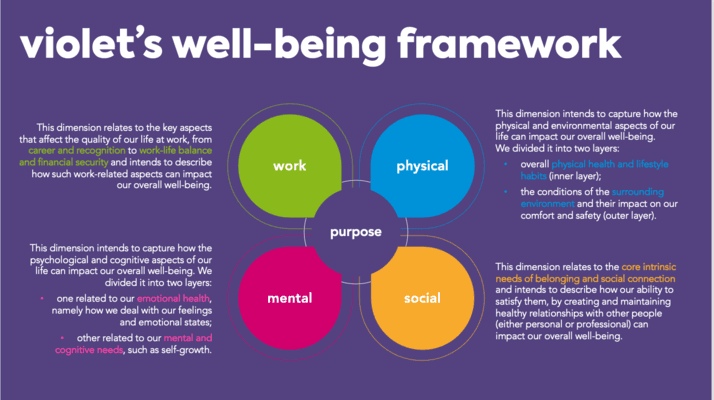
It’s a rather simple but comprehensive approach, designed to measure well-being in a holistic way, but with a pur’ple twist: purpose is framed as the thread that links all other dimensions, since purpose can be found and fostered in all of them.
For us to be able to capture and measure the impact of all these dimensions in our individual well-being, we developed an extensive benchmark research on the most-used survey questions to measure these attributes. All the inputs collected were compiled and framed within each dimension, resulting in violet’s well-being survey.
Finding purpose
As I mentioned before, violet’s model recons that physical, mental, social and work aspects of well-being are all bonded by a common thread: purpose. Purpose can derive from having clear and meaningful goals in life, a sense of direction, holding strong beliefs and using them to guide our daily choices. Framing purpose as the nuclear core of violet’s model allows us to account for the impact that such foundations can have in attaining and sustaining one’s overall well-being.
People who feel they live meaningfully, both in the present and future, tend to have fewer physical challenges, improved mental health, stronger relationships, and higher fulfilment at work, thus living happier lives. That is why we believe purpose can leverage well-being. On the contrary, people who are still thriving to find meaning in life tend to face more challenges when it comes to finding the balance they need, either in terms of physical and mental health, relationships or at work, thus living less happy lives. And that is why we believe purpose can restrain their sense of well-being.
In sum, we believe that purpose and well-being are deeply connected, and one cannot be achieved without the other, as there is a crucial – yet delicate – balance between finding or pursuing one’s individual purpose and fostering one’s well-being.
The journey is just starting
At the end of the day, none of us is a stranger to the concept of well-being – as for me, I have been hearing about it for as long as I can remember. There are thousands of theories out there telling us how to improve our well-being and be happier – eat more avocado, read 1000 books a year, climb Mount Kilimanjaro – but what I have realized is that well-being is a deeply personal journey, and it must start from within. Before we decide to climb a mountain, we must start by looking inside and connect with ourselves.
Each well-being journey is a (very) personal one, but there are tools we can resort to.
As we launch violet into the world, our purpose is precisely that: to help each one of us reflect on our well-being in a mindfully and intentional way – by asking us the questions no one asks us, making us feel heard, and by giving us insights that will change our perspective and help us be more in control of where we are, how we feel and how it impacts our well-being.
But don’t forget that well-being takes time, and it doesn’t happen without intention. For us to ripe the benefits of true and complete well-being, we must take care of it daily. Like a flower that needs to be nourished to grow (otherwise it will whiter), it is crucial we take care of ourselves and keep track of our well-being on a regular basis.
So, if you believe you are ready to start your own well-being journey – or even if you feel you are already in route – here’s my tip: try out violet and equip yourself to the climb. We will never heal unless we try.