


We believe the workspace will morph into a hybrid.
Where previously, employers and employees alike saw only barriers, a virus has succeeded in pushing a significant portion of the workforce into their homes and experience the advantages (and shortfalls) of not commuting to work every day. Moving ahead and managing foreseeable new outbreaks in the short term will reinforce this even more. The physical workplace has given room to a hybrid workplace.
Work from home: a friend or a foe?
As we are writing this article, we are in July, facing particularly warm days. The days are longer and we are working. We feel energized, peaceful and have the conditions to organize our work, be productive and have our working needs fulfilled. We are glad we managed to keep up with the work despite the atmosphere that surrounds us. We feel safe.
If the description above made you remember how you felt, and maybe still feel while working at home, you are part of a group that found working at home a valuable experience. You found you could be as productive as working at the office or even enjoyed avoiding commuting and the flexibility to manage your own schedule and balance your personal and professional life. You are even starting to ask Do I ever need to come back to the office?
Or maybe you belong to that other group, the ones for whom the office description above resonated to. And as shocking as it may seem, at this point the truth is, you are already tired of working at home.
You feel you worked more hours than before and found your house lacked the ideal work environment. From technology issues to dividing the space with your family, to having to home school your kids who normally would be at school. Or working in a small apartment without the possibility to have social interactions, finding it hard to manage the barrier between work and personal life.
When it all started, many companies promptly acted to ensure their employees were safe, took live and livelihood measures while ensuring business operations kept running.
And let’s be honest, it was a task that we would expect only Hercules could handle.
But estimates suggest that, during the lockdown, the proportion of Americans working from home shifted from 31% to 62%[1]. After this, many tech companies took the lead on promoting working from home, sending encouraging messages towards remote work. In a wide-company email, Twitter’s CEO stated You can work remotely “forever”[2], and many others such as Facebook and Google joined the movement extending their work from home policies into 2021.[1]
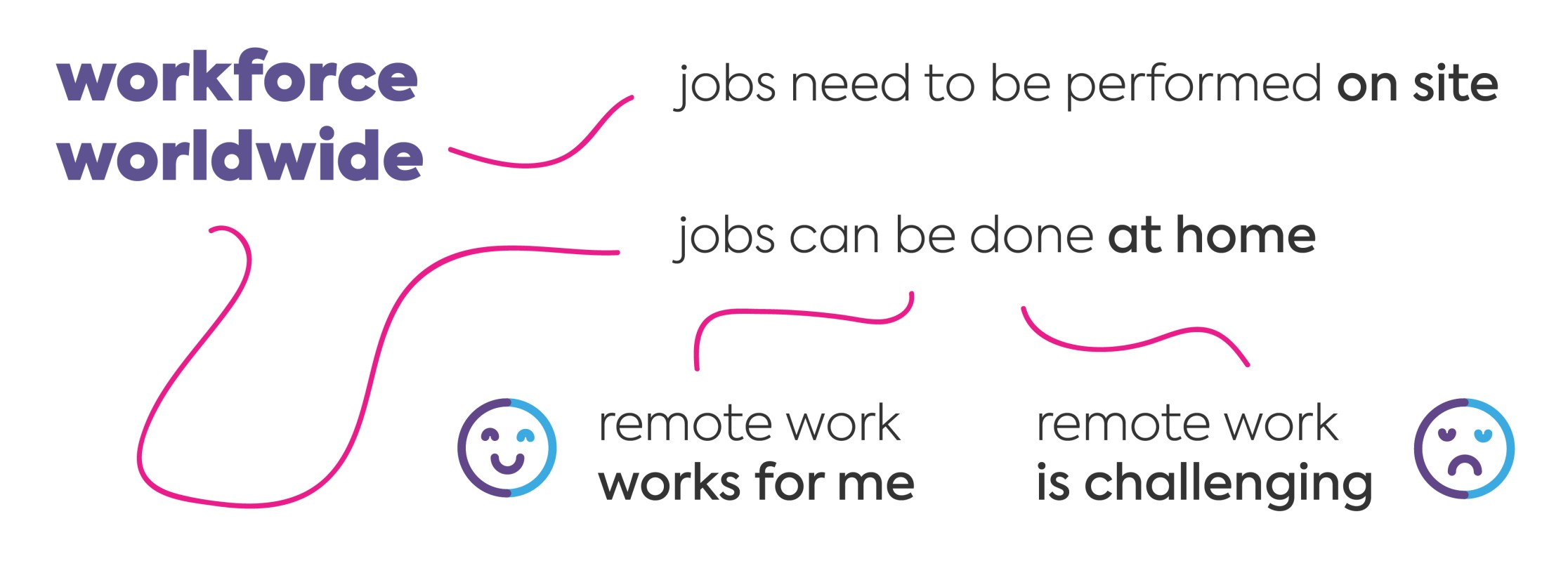
However, as supportive as this shall seem, looking at the global landscape, working from home does not seem to work for everyone. Nor is it simply a matter of giving a laptop and take advantage of the innumerous virtual collaboration tools that people did not even know existed.
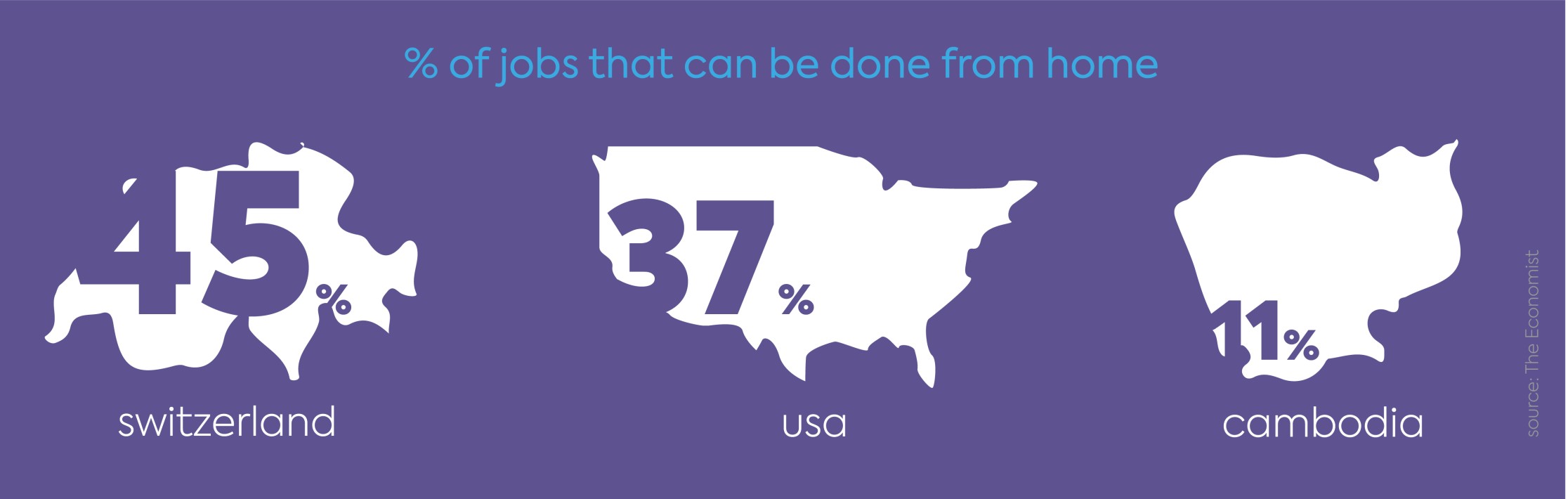
Data from The Economist suggest that those who can work from home are a privileged minority[3] and that it has a positive correlation with the GDP per head: the higher the income per capita, the more people have conditions to work from home. And the correlation will be stronger when one compares the prevalence of the third sector, as most services are prone to enable remote work.
For instance, in Cambodia, only 11% of jobs can be done from home, compared with 45% in Switzerland or 37% in America[3].
Besides, some industries are more suited to working from home than others. Sectors such as agriculture, hotels, sports or restaurants demand on-site work, and jobs such as service attendants, manufacturing engineers or airline pilots, cannot simply be done at home.
Though some do call this a ‘great experiment’, to be fair, the experiment failed the ceteris paribus condition: sending everyone home, maintaining all other aspects constant. It meant working from home without choice, dealing with the fear of a pandemic and respecting social restrictions.
It is true that coming back to the office will not be the same as before. But are we assisting to a true shift towards home working as a new way of working?
This discussion is definitely not new, but seems it cannot be avoided anymore. Companies must start adapting if they have not already done so.
In the end, we at pur’ple believe it will lead to different answers depending on the type of organization, the talent required, the type of work involved, the level of collaboration required and the culture the companies foster. For some organizations, it may also lead to different solutions for different geographies, functions and individuals.
Office sweet home...
The Latin word for office was contracted from opificium, which means “doing work”, suggesting a place where people would practice the continuous act of performing their labor duties.
The origins of the modern office lie in the medieval age, where large-scale organizations such as governments, trading companies and religious orders worked huge amounts of written records or documentation[4]. Apart from that, people did not go to a specific place to perform their duties, as labor would be performed in rural fields, or people would produce hand-made goods at home, receiving for how much they produced or the goods they sold.
Centuries later, the industrial revolution generalized the need to share a common place, as production in mass by machines in factories, would require people to gather in a common place to perform tasks over machinery, and afterward the creation of offices where people would manage the outputs of such work.
The massification of the office led to a cultural distinction between the office - a place related to work, and home - a place related to comfort, intimacy and privacy. Even nowadays, we still feel the office as a mental barrier, as we want to leave work behind when we leave the office or dress differently at the office and at home.
As humankind evolved and adapted to work at the office, organizations started to realize the benefits of offices to foster productivity, act as cultural enablers and attract talent. The baseline lies in the importance of employee experience, and how the experiences organizations design are ultimately what shape the actions that employees take and the relationships they want to have with the organization.[5]
Among other aspects such as organizational purpose, culture or the available technology, the physical environment comprises 30% of the employee experience.[5]
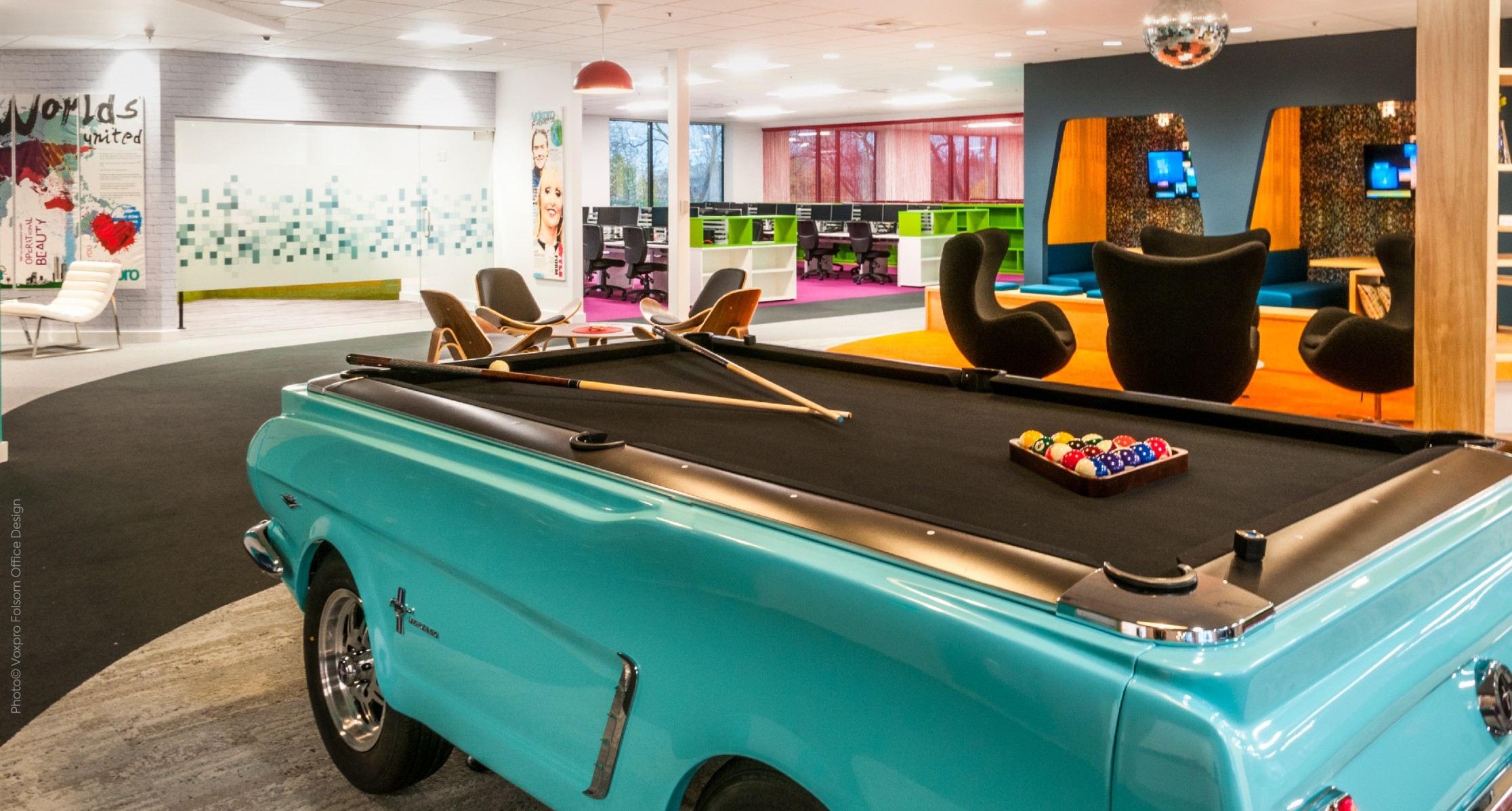
In this sense, throughout the years, companies like Google, Amazon, Cisco, General Electric or Microsoft would compete for office prime space to create centers of employee experience. Including their office spaces and amenities in their Employee Value Proposition, they want to send a positive message: at the office, people can connect, socialize or invest in their wellness, as a way to increase collaboration, feel energized and connected to the company.
Going beyond, in 2012, Yahoo’s CEO wrote on a controversial memo: “To become the absolute best place to work, communication and collaboration will be important, so we need to be working side-by-side. […]. We need to be one Yahoo!, and that starts with physically being together.”[6]
Though at the time people were shocked by such words, let’s be honest: we don’t want to go to the office to share a common place where we simply look at the computer and perform a set of tasks. Rather, going to the office makes us feel more connected with the company’s purpose, to learn and to have social interactions that make us feel human.
The link between work and the office is so intimate that when we refer going to the office to perform our work, we say: we go to work
…or home sweet office?
Ask a writer, a couturier or an artisan if working from home is the future of work and they’ll probably laugh at you. Traditionally, these roles have always been performed at home, proving that working from home is not new.
Thinking about the type of jobs that have traditionally been performed at home, one can establish a relationship with the level of collaboration required: it suggests tasks that did not require collaboration, would be done at home.
Similarly to COVID-19, the financial recession of 2008, contributed to an acceleration of the usage of technology for collaboration. Pressured by cost reduction, companies started to adopt alternatives to face-to-face meetings that involved traveling, with 59% of executives interviewed by Forbes[7] saying that their use of technology-driven meetings increased during that period.
After that, an increasing number of companies started creating the conditions to support flexible work, and many employees started to understand that some parts of their job could perfectly be done away from the office.
The increasing connectivity and accessibility broke the physical barrier between the office and work, and a growing part of the global workforce started to work everywhere. And, with flexible work arrangements and technology that follow us home after the workday ended, our personal and professional lives were not truly separated a long time ago, with many already experiencing some kind of home-working.
With the lockdown, remote work proved that, where possible, was here to stay. Many companies realized it was perfectly feasible: they saw the levels of productivity and engagement increase[8], while employees were delighted with the time they saved on commuting, how they could manage their own schedule, and balance their personal and professional lives.
From an organizational perspective, this opens a wide range of opportunities, as it promises greater access to talent. In this post-crisis future, telecommuting will be key to cope with global competition, demographics changing and skill shortages. Besides, it may be a source to attract a wide array of employees and recruit diverse talent, while broadening the access to international talent at a more competitive price.
Finding the right balance
The physical workplace has given room to a hybrid workplace, and we at pur’ple, believe companies must take this into account to manage their employee experience.
For many, nowadays, working means being a great part of their time away from their desk. Following this trend, many companies have been redesigning their workspaces, towards more flexible, cleaner and more open environments, sending messages of transparency, collaboration and openness.
From now on, people will want to fully control when and where they work. People will want to work where they feel is best for them or where they can get their job done, either by going to the office or staying at home, at a coffee shop or a coworking facility.
We believe there are some key aspects to consider when thinking about this hybrid workplace:

Put strategic into workforce planning
If traditional workforce planning, based on headcount, assuming continuity and projecting numbers for the future was not working, now it will become obsolete.
Get strategic
Translating strategy into people’s requirements, will mean find the strategic capabilities and roles needed to deliver it, and these won’t be just around the corner or willing to move to another country. Finding the strategic capabilities and roles will mean looking at the global landscape and consider key contributors with the right skills working far from the office.
Manage the hybrid
Workforce mapping will require analyzing which roles may be performed on-site vs remote jobs. This will lead to different models of work for employees at the same company, entailing different pay policies and contractual relationships.
Reimagine the notion of space
If workspaces were changing to foster employee experience, from now on, they will truly metamorphize.
Offices as forums
Whether people can, in general, go to the office only two or three days per week to deal with matters that require physical presence and do the remaining work remotely, no fixed sits will be required. Rather, similar to the classical antiquity era, offices will transform into forums to ideate, work on topics where collaboration is essential, work in complex and important matters and grow.
Offices become networks
People who did not have a great experience working at home maybe won’t say no to remote work, as long as they can avoid the time spent on commuting and be able to perform their work at any space near home. This will transform the office into a network of spaces, either at home or small offices in specific locations, or agreements with co-working facilities with spaces throughout the country. No matter where the office is, it will increasingly become digital, as it will be transferred to people’s laptops and mobile phones, with companies having to make sure that taking work everywhere will not harm privacy: from both the employees and the company’s point of view.
Offices at home
Where work can be fully remote, companies may decide to give their employees the required tools, or introduce allowances to cover the required expenses for proper home work: establishing partnerships with telco operators to ensure communications and internet coverage or providing a budget for home office, from ergonomic chairs to adequate lightning or air conditioner.
Create a wider sense of engagement
Engaging a diverse workforce required sophisticated models and systems. Now it will demand an integrated and real-time living and breathing organism.
Replace the social informal
While working from home, people may feel isolated, miss the social interaction or the informal rules that help bind the company’s culture. This may harm the sense of belonging, or impact mental wellness. Finding alternative ways to ensure people feel connected to the company’s purpose, such as daily check-ins, alternative communication tools or remote informal interactions, is imperative.
At home people work by their own rules
Everyone got delighted with the freedom to manage their schedule and decide where to work. People expect flexibility. It will be important to manage the employer-employee relationship, making sure people are willing to receive orders at their own house. Establishing the frequency and timing for communication and delivery will be key.
Worklife balance
Breaking the physical barriers of the office may open the door to full-time connection. It is true remote workers will want flexibility, but that does not mean they need to be connected all the time or expect others to be always online.
Accept a new paradigm on human capital management
Business as usual will not work anymore, and how employees are managed will also change.
A new way of supervision
Managers are used to face to face interaction as a way of getting mutual knowledge and trust. This will require training towards trusting the work is done by someone they do not personally know or control.
New sources of interaction
When managing at a distance, communication may be damaged as that quick exchange of ideas is now at the distance of a teleconferencing tool. Processes must be in place to ensure delegation is done correctly and people do not spend time understanding what is expected from them or finding the information they need to get the work done.
Multi-employer relationship
While at home, people may have discovered they have other talents or feel energized by combining their professional work with other activities. This may lead to remote workers sharing their contractual relationship with more than one company, ending with a different sense of belonging and relationship among various employers.
In the midst of so much uncertainty, it’s hard for companies to find the right fit. At this stage, the answer seems quite clear: giving people options. Getting a balance advantage of the benefits of remote work, not forgetting the power of offices.
In the end, companies should not put hybrid only on the workspace. Taking good care of what they want for the company in terms of norms, leadership, culture and purpose will be key.
***
Read more about our Trends’formation of work articles:
chapter 1 – seven drivers that shape the future
chapter 2 - purpose is an imperative
chapter 3 - rewire leadership
chapter 4 - organizations become ecosystems
chapter 5 - digital as a human experience
[1] Megan Brenan, “US workers discovering affinity for remote work”, Gallup, April 3, 2020
[2] The Guardian, “Twitter announces employees will be allowed to work from home ‘forever’”: A Spokesperson of Twitter confirmed the decision and even stated that all employees in a role and situation that enables them to work from home and they want to continue to do so forever, we will make that happen.”
[3] The Economist, “Covid-19: is working from home really the new normal?”
[4] August Chevez, DJ Huppatz, “A short history of the office”
[5] Morgan, Jacob. The Employee Experience Advantage (p. xix), 2017
[6] The New York Times, “Yahoo Orders Home Workers Back to the Office”, by By Claire Cain Miller and Catherine Rampell
[7] Forbes Insights: “The case for face-to-face”
[8] Gallup, “Is Working Remotely Effective? Gallup Research Says Yes”